

Margaret Curtin, Curi Advisory Risk Consulting, shares why your practice or hospital needs a comprehensive workplace violence prevention plan—and how you can create one to protect your team.
I was leaving work, making my way down the hallway that connected my office to the parking ramp shared with the hospital, when a security guard stopped me to say the building was on lockdown. An event at the hospital triggered their active shooter protocol. It was frightening, even though I wasn’t directly involved.
If you work in a healthcare setting, be it a hospital or medical office, you surely have your own story or stories of encounters with perpetrators of violence—likely even more up close and personal.
As a risk professional, I want to do everything possible to support organizations in preventing workplace violence. One way to combat it? Having a strong workplace violence prevention plan in place. Read on for powerful insights and tips for implementing an effective program.
Key Takeaways:
- Workplace violence in healthcare is common.
- Healthcare workplace violence exists in many forms and can stem from a variety of factors, some of which are uncontrollable but are manageable.
- Violence against nurses and other healthcare staff is costly; the cost to hospitals in 2023 was estimated at more than $18 billion.
- A comprehensive workplace violence prevention plan that is proactive, structured, and rooted in evidence can help protect employees.
Workplace Violence: An Unfortunately Common Problem
It’s not at all uncommon for me to hear from healthcare professionals during my risk assessment interviews that they feel unsafe in their jobs and at their workplace. Often, they report some level of verbal abuse or incivility from patients, family members, and even colleagues. The most challenging conversations are when they report having been physically attacked (hit, kicked, pushed, etc.).
In fact, most healthcare professionals don’t report violent acts because the experiences have become so commonplace they expect them. Many say that even if they do speak up, nothing will change.
As a health system or hospital risk professional, you know things aren’t great out there lately. I read a recent article about a situation that occurred in the Midwest where a man was arrested in connection to an alleged bomb threat at a health center because he was “on hold too long.” While this seems like an extreme reaction to frustration, other more common acts of violence against healthcare professionals take place every hour.
Your team shows up to heal, comfort, and support, yet they’re increasingly being assaulted and intimidated. These are not isolated events. Fortunately, there is much you can do to prevent or lessen them. Keep reading.
The Nature of Workplace Violence in Healthcare
To create a strong workplace violence prevention plan tailored to your org, you first need to know the four Ws of healthcare workplace violence. Here’s what the current research says and what I’ve found in my risk management experience.
-
Where: The most frequent locations for violence in hospitals are psychiatric departments, emergency departments (EDs), waiting rooms, and geriatric units, with rural areas having higher rates than urban areas.1,2
-
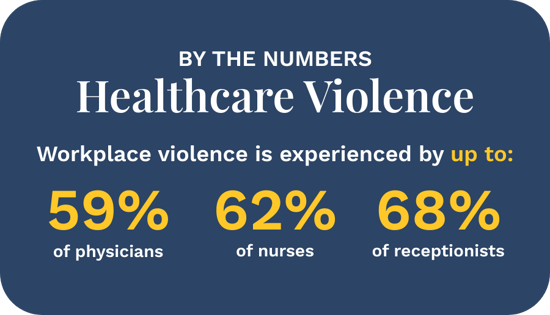
Who: Estimates of the prevalence of workplace violence against physicians range from 24.4% to 59.3%; from 9.5% to 62.1% against nurses; and from 15.1% to 68.4% against receptionists.2 Registered nurses (RNs), nursing assistants, and patient care assistants experience particularly high rates of workplace violence.3,4
-
What: The types of violence that appear to be most rampant are threats, bullying, physical assault, sexual assault, and harassment.
-
Why: Although violence is always inexcusable, it makes sense why healthcare settings are more prone. Patients may be in high levels of pain, coping with substance abuse, or experiencing mental and cognitive issues that may cause them to lash out. These environments, particularly the ED, can be chaotic and high stress, leading to panic and frustration.
Often, acts of violence start in the community and follow the injured person into the healthcare organization: first into the ED, then into the inpatient setting, and even after discharge into the medical office for follow-up care. No setting, no specialty, and no healthcare clinician is immune from acts or potential acts of violence.
The Financial Cost of Violence
The American Hospital Association (AHA) recently released a comprehensive report by the Harborview Injury Prevention & Research Center, part of the University of Washington's School of Medicine, stating that the total annual financial cost of violence to hospitals in 2023 was estimated at $18.27 billion. The study sought to estimate the costs and other impacts associated with workplace and community violence.
The researchers estimated pre-event costs at $3.62 billion, primarily for prevention measures. They cited post-event costs, including healthcare, work loss, case management, staffing, and infrastructure repair, as $14.65 billion.
In a world of consolidations, mergers, closures, and bankruptcies, healthcare delivery systems can't afford to lose billions and must implement or enhance violence prevention programs.
Implementing a Workplace Violence Prevention Program
A comprehensive workplace violence prevention plan is proactive, structured, and rooted in evidence. The roadmap to and key components of a healthcare workplace violence prevention program include:
Workplace Hazard Assessments
Taking an assessment is your first step. It will provide the information you need to create a tailored plan. You have the option to use tools available for free or purchase and conduct the assessment yourself, or you can use a partner with expertise in this area to conduct the assessment with you (including Curi; see below).
Either option aims to identify your organization’s high-risk areas, times, and patient populations. With this knowledge, you can then apply targeted interventions—such as modifying physical layouts, adjusting staff, or conducting patient screening protocols—that can reduce the likelihood of violence.
Workplace Violence Prevention Training
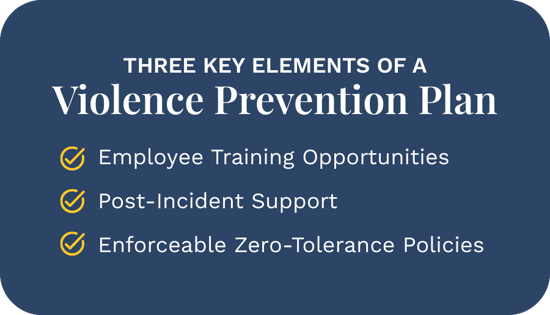
A complete plan will provide employees multiple training opportunities, including:
- Situational Awareness/Early Recognition of Escalating Behavior: Situational awareness training teaches how to observe and interpret subtle cues that might indicate a person is becoming agitated or aggressive. It often involves role-playing, real-life scenario simulations, and reflection exercises. It’s not just about what’s happening—it's about anticipating what might happen next.
- De-escalation Techniques: Everyone, from nurses to transport aides, should also go through simulation-based de-escalation training. Learning how to recognize early signs of agitation, position oneself safely, and use voice and body language effectively can help prevent a situation from escalating.
Post-Incident Support
After an incident, it's not enough to fill out a report and move on. Offer debriefs, counseling, and modified shifts for team members who’ve been impacted. Violence is traumatic, and healing isn’t measured by a clock.
Zero-Tolerance Policies That Are Enforced
Too often, organizations post signs that say, “violence will not be tolerated,” but don’t back it up with action. A real policy means supporting staff who report violence, pressing charges when appropriate, and refusing to allow abusive behavior to go unchecked just because someone is ill.
A Culture Shift
As mentioned above, hospital and practice staff have often told me they don’t speak up because they don’t think it will make a difference. They’ve been met with excuses that this type of behavior just comes with the territory and shown that not only is it to be expected, it’s also to be tolerated.
As part of a prevention plan, the culture itself must shift from complacence to zero tolerance. Leadership must send a clear message: Violence is not part of the job. They must deliver consistent action that shows employee safety is as important as patient safety. When people know they’ll be believed, protected, and supported, they’re more likely to report incidents, speak up early, and stay engaged in prevention efforts.
How Curi Can Help
We know it’s immensely difficult for you to see your team impacted by violence, and that you want to do everything you can to extend compassion to those providing compassionate care every day.
Implementing a workplace violence prevention plan isn’t a five-minute fix, but it is a manageable must for your healthcare organization. And we’re here to help.
Curi Advisory Risk Consulting, powered by ERC Risk, is your partner for conducting workplace hazard assessments, implementing a comprehensive prevention program, and delivering ongoing educational support and advisement for your workplace violence prevention efforts. Let us assist you in both keeping your team safe as well as meeting your regulatory requirements under CMS and the Joint Commission.
Contact me directly at margaret.curtin@curi.com, or visit our webpage to learn about all we offer: curi.com/advisory/risk-consulting.
Workplace Violence Prevention Resources
ASHRM Health Care Facility Workplace Violence Risk Assessment Toolkit
AHA Workforce and Workplace Violence Prevention
ENA Workplace Violence Resources
References:
- Mento, C., Silvestri, M. C., Bruno, A., Muscatello, M. R. A., Cedro, C., Pandolfo, G., & Zoccali, R. A. (2020). Workplace violence against healthcare professionals: A systematic review. Aggression and Violent Behavior, 51, Article 101381. https://doi.org/10.1016/j.avb.2020.101381
- Pompeii, L., Benavides, E., Pop, O., Rojas, Y., Emery, R., Delclos, G., Markham, C., Oluyomi, A., Vellani, K., & Levine, N. (2020). Workplace Violence in Outpatient Physician Clinics: A Systematic Review. International journal of environmental research and public health, 17(18), 6587. https://doi.org/10.3390/ijerph17186587
- Wakim, N., Bermudez, N., & Sabogal-Rodriguez, C. C. (2022). Exploring Workplace Incivility and Bullying in Healthcare Workers in a South Florida Community Hospital. Nursing & Health Sciences Research Journal, 5(1), 4-18. https://doi.org/10.55481/2578-3750.113
- Medvec, B. R., Marriott, D. J., Khadr, L., Ridge, L. J., Lee, K. A., Friese, C. R., & Titler, M. G. (2023). Patterns and Correlates of Nurse Departures From the Health Care Workforce: Results From a Statewide Survey. Medical care, 61(5), 321–327. https://doi.org/10.1097/MLR.0000000000001837
SHARE THIS POST











Comments